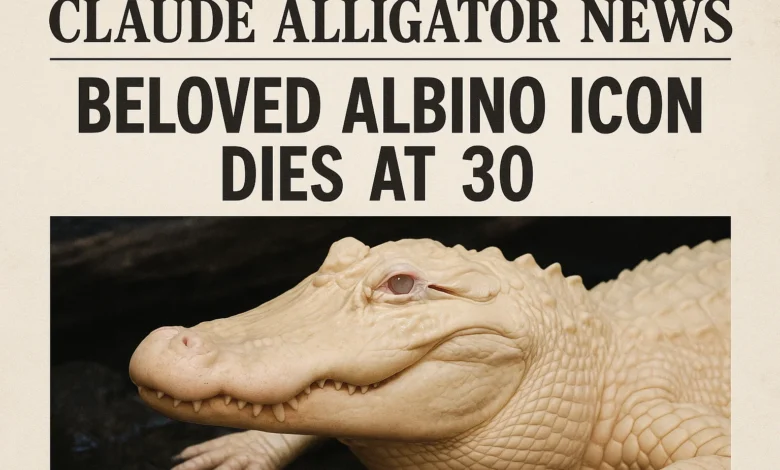
San Francisco is mourning the loss of one of its most unusual celebrities. Claude, the albino alligator who lived at the California Academy of Sciences, passed away at age 30 after treatment for a suspected infection. For nearly two decades, this snow-white reptile captivated millions of visitors, became the museum’s unofficial mascot, and taught countless children about wildlife conservation and genetic diversity.
The claude alligator news has touched hearts worldwide, with tributes pouring in from government officials, scientists, and everyday visitors who formed deep connections with this extraordinary animal. This is the story of Claude’s remarkable life and lasting legacy.


Who Was Claude the Alligator?
The Rare White Gator That Captured Hearts
Claude was born with albinism, a genetic mutation that gave him a white appearance and pinkish-red eyes caused by visible blood vessels through his clear irises. This extremely rare condition made him one of fewer than 200 albino alligators in the world.
Claude’s Journey:
- Hatched September 15, 1995, in Louisiana
- Spent 13 years at St. Augustine Alligator Farm in Florida
- Arrived at California Academy of Sciences in 2008
- Lived 17 years in San Francisco’s Golden Gate Park
- Measured 10 feet long and weighed 300 pounds
Why Albino Alligators Are So Special
Albino alligators face significant survival challenges in the wild. Their white coloring makes them highly visible to predators and prevents them from effectively hunting prey. Most albino alligators are found in zoos and aquariums where they can receive UV-safe lighting, shaded refuges, and specialized diets.
While these genetic differences make survival difficult in nature, they also create incredible teaching opportunities about biodiversity and adaptation.
Breaking Claude Alligator News: What Happened?
The Final Days
In recent weeks, Claude showed signs of a declining appetite and was moved behind-the-scenes to receive specialized care. Despite intensive veterinary treatment for a suspected infection, the beloved alligator passed away on December 2, 2025.
The California Academy of Sciences announced they would conduct a complete necropsy at UC Davis School of Veterinary Medicine to determine the exact cause of death and contribute to scientific understanding of albino alligator health.
A Life Cut Short
While alligators in human care can typically live 60 to 70 years, Claude’s death at 30 came as a shock to his caregivers and fans. The museum described this outcome as heartbreaking and not what they had hoped for after his recent health decline.
Claude’s Impact on San Francisco and Beyond
More Than Just a Museum Exhibit
Claude became far more than an aquarium resident. He transformed into a cultural icon who:
- Starred in a dedicated children’s book
- Featured in citywide advertising campaigns
- Received fan mail and artwork from around the globe
- Had a 24/7 livestream launched in 2024
- Attracted millions of visitors to the Academy
Museum staff called him their “iconic swamp king,” and thousands attended his 30th birthday celebration in September, where he received a special cake made of fish and ice.
Political Tributes and Public Recognition
The claude alligator news prompted responses from high-profile figures. Former House Speaker Nancy Pelosi shared that San Francisco was heartbroken by losing Claude, calling him a cold-blooded icon who connected millions to the wonders of science.
Mayor Daniel Lurie had recently declared September 15 as “Claude the Alligator Hatch Day” during the birthday festivities just months before his passing.
The Science Behind Claude’s Story
Understanding Albinism in Reptiles
Albinism results from a genetic mutation affecting melanin production. In Claude’s case, this single DNA variation created his distinctive appearance and taught valuable lessons about:
- Genetic variation and evolution
- Adaptation challenges in wildlife
- The importance of protected environments
- Conservation of unique animals
Educational Legacy
Claude served as a living classroom for topics including:
- Wildlife biology and reptile behavior
- Genetic diversity and mutations
- Conservation challenges
- Human-animal connections
Educators used Claude to discuss how DNA sensitivity affects survival and why genetic variation matters in evolution.
Life at the California Academy of Sciences
Claude’s Daily Routine
Visitors could observe Claude in his carefully maintained swamp habitat within the Steinhart Aquarium. His behaviors included:
- Floating motionlessly for extended periods
- Peaceful coexistence with turtle companions
- Basking under specialized UV-safe lighting
- Occasional dramatic feeding demonstrations
The Infamous Toe Incident
Claude wasn’t always a solo resident. Years ago, academy staff attempted to house him with another alligator. The experiment ended poorly when a confrontation resulted in Claude losing a toe. He recovered fully and returned to his preferred solitary lifestyle, occasionally sharing space with turtles.
How Fans Are Remembering Claude
Global Outpouring of Grief
The claude alligator news sparked an emotional response worldwide. The museum’s social media filled with tributes, memories, and childhood photos taken beside his exhibit.
Fans remember:
- His mesmerizing stillness that made visitors question if he was real
- The excitement when he finally moved
- Teaching moments parents shared with children
- School field trip memories spanning decades
Honoring His Memory
The California Academy of Sciences is planning a public memorial service. In the meantime, they encourage fans to share memories and messages for Claude’s care team via:
- Email: claude@calacademy.org
- Traditional mail to the museum
- Social media tributes using dedicated hashtags
The Future Without Claude
What Happens Next?
The museum faces the challenge of moving forward without their most recognizable resident. Claude’s habitat in the Steinhart Aquarium will undergo changes, though specific plans haven’t been announced.
The academy emphasized that Claude’s legacy will continue through:
- Educational programs developed around his story
- Continued conservation messaging
- Archives of photos, videos, and fan contributions
- Scientific knowledge gained from his care
Lessons That Live On
Claude demonstrated the power of ambassador animals to create connections between humans and nature. His ability to spark curiosity made him invaluable for conservation education.
Future visitors will still learn from Claude’s story, even in his absence, understanding how one unique animal can inspire millions to care about wildlife protection.
Conclusion
The latest claude alligator news marks the end of an era for San Francisco’s California Academy of Sciences. Claude’s passing at age 30 leaves a void that extends far beyond his physical habitat. This remarkable albino alligator taught generations about genetic diversity, conservation, and the unexpected ways animals can touch human hearts.
For 17 years, Claude served as a bridge between people and nature, proving that even a motionless reptile could inspire wonder and curiosity. His legacy lives on in the countless children who learned about science through his story, the families who made visiting him a tradition, and the conservation efforts he represented.
As San Francisco mourns its distinguished albino alligator, the world is reminded that sometimes the most impactful teachers have scales, live in swamps, and communicate through quiet charisma rather than words.
Rest in peace, Claude. Your impact will ripple through time, just like the gentle movements you made through your beloved habitat.
FAQs
Q: How old was Claude when he died?
A: Claude was 30 years old when he passed away on December 2, 2025. This is considered relatively young for an alligator in captivity, where they typically live 60-70 years.
Q: What caused Claude’s death?
A: Claude was being treated for a suspected infection and showed declining appetite in his final weeks. A necropsy at UC Davis will determine the exact cause of death.
Q: How rare are albino alligators?
A: Extremely rare. Fewer than 200 albino alligators exist worldwide, almost exclusively in captivity since they cannot survive long in the wild due to their visibility.
Q: What made Claude so special?
A: Beyond his rare albinism, Claude had a unique “quiet charisma” that captivated visitors. He became an unofficial mascot for both the museum and San Francisco, connecting millions of people to wildlife education.
Q: Will the museum get another albino alligator?
A: The California Academy of Sciences hasn’t announced plans regarding Claude’s replacement. Given the rarity of albino alligators, any such decision would require careful consideration.
Read More: A Heart Surgeon’s Confession Changes Everything